Boron and Testosterone: Two Small Trials That Don't Fully Agree
Boron amino acid chelate is the eighth and last ingredient on SodaPeak's label — the smallest share of the blend, and the only one of the eight that's a mineral rather than a plant. It's also the ingredient with the most directly relevant human hormone research of anything on this bottle. Here's what two small trials, thirteen years apart, actually measured.
On this page
- The odd one out at position eight
- What "boron amino acid chelate" means as a supplement form
- No RDA, a WHO safe range, and an upper limit
- Trial one, 1997: estrogen rose, testosterone didn't — significantly
- Trial two, 2011: testosterone rose, estrogen fell
- Two trials, one overlapping author, opposite estrogen direction
- Boron's better-established research lane: joints, not hormones
- What SodaPeak's own label doesn't say
- Bottom line
Short version: Two small human trials tested daily boron supplementation against male steroid hormones. One, in 1997, found estradiol rose significantly and testosterone showed only a non-significant upward trend. Another, in 2011, found free testosterone rose and estradiol fell — the opposite direction on estrogen. Both trials had fewer than twenty men. Neither has been repeated at scale. "Boron raises testosterone" is a simplification of a genuinely mixed, very small evidence base.
The odd one out at position eight
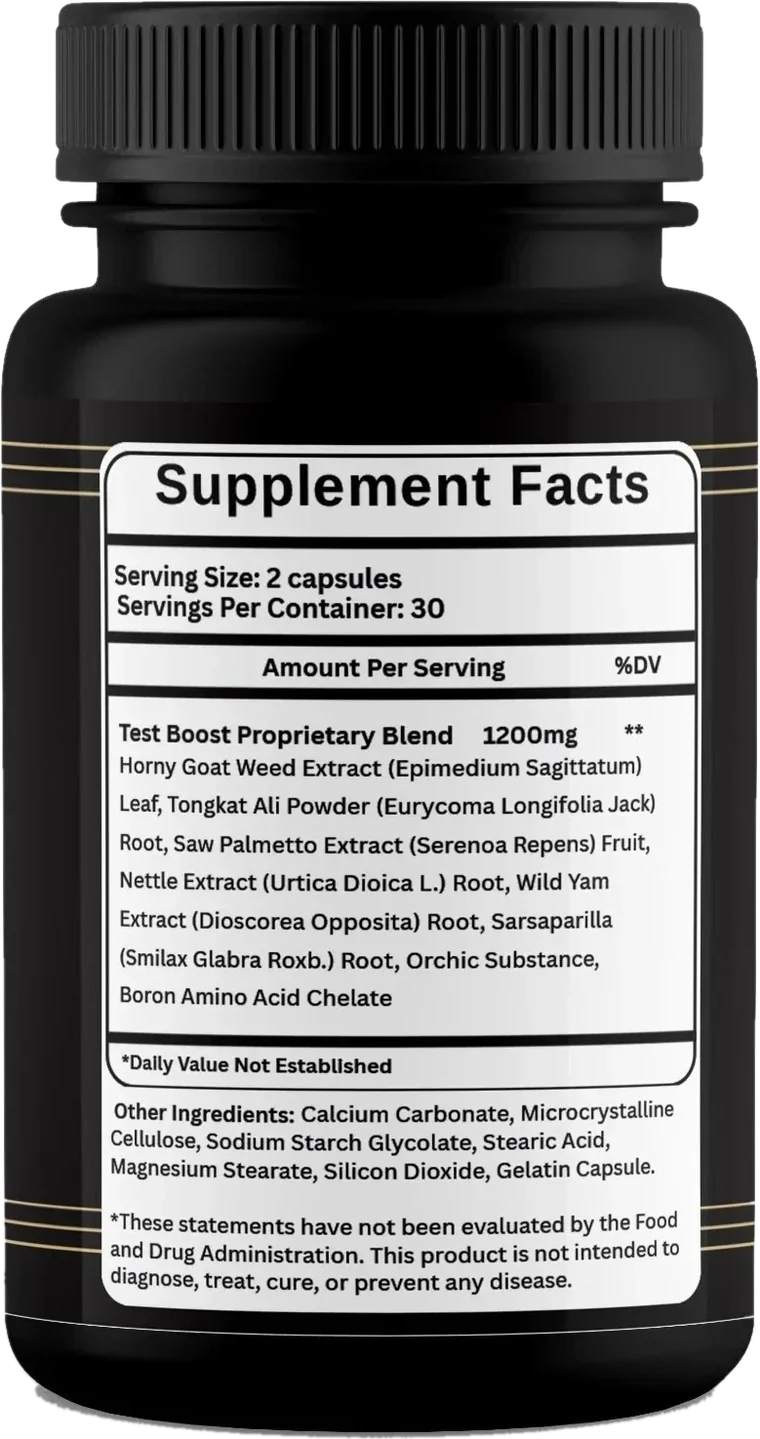
Seven of SodaPeak's eight Test Boost Proprietary Blend ingredients are botanicals — leaves, roots, and one animal-derived glandular substance. The eighth, boron amino acid chelate, is a trace mineral, and its position last on the label matters under standard descending-order-by-weight labeling: whatever the actual milligram split of the 1,200 mg blend turns out to be, boron is the smallest declared share of it. That position doesn't diminish the ingredient's research interest, though — if anything, boron is the one name on this label with genuine, published human-hormone trial data behind it, which makes it worth reading closely rather than skipping past as an afterthought.
What "boron amino acid chelate" means as a supplement form
The National Institutes of Health's Office of Dietary Supplements (ODS) publishes a detailed fact sheet on boron for health professionals, and it specifically names "boron amino acid chelate" as one of several forms boron takes in dietary supplements — alongside sodium borate, sodium tetraborate, boron citrate, boron glycinate, boron picolinate, and calcium fructoborate, among others. A chelate simply means the mineral is bound to an organic molecule (here, an amino acid) rather than sold as a simple inorganic salt; ODS notes that common amounts of elemental boron across commercial supplements range from about 0.15 to 6 mg per product, and that no published data compares the relative bioavailability of these different chelate forms against each other. In other words: the form named on SodaPeak's label is a real, recognized supplement form — the research below just doesn't tell us how much of it is actually in this specific bottle.
It's also worth naming what boron amino acid chelate is not, since the category has several boron forms that show up in different studies. Calcium fructoborate — the form used in the joint-inflammation trials discussed later in this article — is a distinct, naturally occurring sugar-borate complex, not an amino acid chelate. Sodium tetraborate, the form used in an early bioavailability study ODS cites, is a simple inorganic salt. None of the human trials cited in this article used boron amino acid chelate specifically; they used elemental boron supplements without specifying a chelate form, or in one case a different chelate entirely. That's a minor point but a real one: "boron" research and "this specific chelate form of boron" research aren't automatically interchangeable, even though the underlying element is the same.
No RDA, a WHO safe range, and an upper limit
Boron is not classified as an essential nutrient for humans, because researchers haven't yet identified one clear, required biological function for it the way they have for, say, iron or vitamin C. The U.S. Food and Nutrition Board has reviewed the evidence and found it insufficient to set a Recommended Dietary Allowance, an Adequate Intake, or an Estimated Average Requirement for boron — there simply isn't a target daily number the way there is for most nutrients. The World Health Organization has published its own estimate of an "acceptable safe range" of boron intake for adults: 1 to 13 mg per day. Separately, the Food and Nutrition Board has set a Tolerable Upper Intake Level — the highest daily amount, from all sources combined, judged unlikely to cause adverse effects — at 20 mg per day for adults 19 and older. For context, typical U.S. dietary boron intake from food alone runs about 1 to 1.5 mg per day, mostly from fruit, legumes, coffee, milk, and wine.
Trial one, 1997: estrogen rose, testosterone didn't — significantly
The human boron-and-hormones research line actually starts earlier than either trial below: a small 1987 study in the FASEB Journal put 12 postmenopausal women, aged 48 to 82, on a low-boron diet for 119 days and then supplemented them with 3 mg of boron per day, reporting that supplementation "markedly elevated" both serum estradiol and serum testosterone — an effect the researchers noted was stronger in the women who were also on a low-magnesium diet.6 That makes it the earliest published human evidence that repleting a boron-deficient diet could move steroid-hormone measurements — in women, not men, following a specific depletion-then-repletion protocol rather than a simple supplement added on top of a normal diet. It's cited here only for context: the idea that boron interacts with steroid hormone metabolism is roughly four decades old, and it didn't start with either of the two men-focused trials below.
The earlier of the two directly relevant human trials in men, published in Biological Trace Element Research in 1997, studied 18 healthy male subjects given 10 mg of boron per day for four weeks, measuring urinary boron excretion, blood lipids, and plasma steroid hormones before and after.1 The result the paper reports most clearly: plasma estradiol concentrations increased significantly as a result of supplementation, from an average of 51.9 to 73.9 pmol/L (p < 0.004). Plasma testosterone showed, in the authors' words, only "a trend" toward increase — not a statistically significant one. Boron absorption was efficient (84% of the supplemented dose was recovered in urine), and lipid profiles didn't change. The authors' own interpretation of the rising estradiol was not "this builds muscle" — it was that elevated endogenous estrogen might play a protective role against atherosclerosis, a cardiovascular framing, not a muscle-and-performance one.
Trial two, 2011: testosterone rose, estrogen fell
A second trial, published in the Journal of Trace Elements in Medicine and Biology in 2011, took a different design: eight healthy male volunteers were given a single 10 mg boron capsule and tracked over six hours, then given the same 10 mg daily for a week, with blood drawn on day 0 (placebo), day 1, and day 7.2 Within six hours of a single dose, the researchers measured a significant drop in sex hormone binding globulin (SHBG) and two inflammatory markers, high-sensitivity CRP and TNF-α. After one week of daily supplementation, mean plasma free testosterone increased and mean plasma estradiol decreased significantly — the opposite direction on estradiol from the 1997 trial. Dihydrotestosterone, cortisol, and vitamin D were also elevated at one week, and all three inflammatory markers stayed down. The authors describe their own free-testosterone finding as notable: "this must be the first human study report to show an increase level of free testosterone after boron consumption."
Two trials, one overlapping author, opposite estrogen direction
Both of these are real, peer-reviewed, published human trials — not animal studies, not in-vitro work. Read together, though, the picture is more complicated than "boron raises testosterone" suggests:
| Trial | n | Duration | Testosterone finding | Estradiol finding |
|---|---|---|---|---|
| Naghii & Samman, 1997 | 18 men | 4 weeks, 10 mg/day | Trend upward, not significant | Significant increase |
| Naghii et al., 2011 | 8 men | 1 week, 10 mg/day | Significant increase (free testosterone) | Significant decrease |
The lead investigator overlaps between the two papers, the daily dose is the same (10 mg), and both studied healthy men — yet the estradiol result runs in opposite directions, and only one of the two trials found a statistically significant testosterone change at all. That's not a contradiction that invalidates either paper; small differences in study duration (one week versus four), sampling schedule, and cohort size can genuinely produce different results in a mineral-hormone system this complex. It does mean two small trials — 18 and 8 men respectively, neither replicated independently at a larger scale — are the entire directly-relevant human evidence base behind any claim that boron supplementation predictably raises testosterone in men. A 2020 short review in Advances in Nutrition by two of the field's most-published boron researchers describes boron's possible role in "the function of steroid hormones" as one of several areas of ongoing interest, alongside bone formation, immunity, and brain function — a broad, still-developing research picture, not a settled mechanism.3
Boron's better-established research lane: joints, not hormones
If there's a health area where boron's human-trial evidence is more consistent, it isn't hormones — it's joint inflammation. A 2014 double-blind, placebo-controlled clinical trial gave 60 adults with self-reported knee discomfort either a placebo or 6 mg per day of boron (as calcium fructoborate, a different chelate form than the amino acid chelate on SodaPeak's label) for two weeks, and found a significant reduction in knee discomfort in the supplemented group.4 A broader 2015 review in Integrative Medicine, titled "Nothing Boring About Boron," surveys this wider literature — bone health, osteoarthritis, cognitive function, and hormone metabolism among the areas covered — and treats the hormone research specifically as preliminary, one strand among several rather than boron's best-supported effect.5 The pattern worth noticing: boron's most-replicated positive human findings involve joint inflammation markers at doses around 3 to 6 mg per day, not the steroid-hormone story that tends to get emphasized in men's-supplement marketing.
Animal research adds a further layer without resolving the human picture. A 2022 study in Reproduction in Domestic Animals gave male goats dietary boron and reported effects on testicular function and thyroid activity, tied to expression of a gene called CYP17A1 that's involved in steroid hormone synthesis — a mechanistic clue about a pathway boron might act through, in a species that is not a human.7 Mechanistic animal data like this is useful for generating hypotheses about how boron could plausibly influence steroid hormones at a cellular level. It is not a substitute for the two small human trials above, and it doesn't resolve the disagreement between them.
What SodaPeak's own label doesn't say
SodaPeak's Supplement Facts panel prints "Boron Amino Acid Chelate" as the eighth and final ingredient inside the 1,200 mg Test Boost Proprietary Blend, with no individual milligram amount disclosed — standard practice for a proprietary blend, and not a claim this label makes that it doesn't back up, since no ingredient in the blend gets an individual figure. But it does mean the two human trials above, both using a precisely known 10 mg daily dose, can't be matched against whatever boron actually amounts to in a capsule here. Being the smallest-by-weight of eight ingredients inside 1,200 mg total puts a rough ceiling on it, but a ceiling isn't a number, and neither trial's finding can be assumed to transfer to an unknown, likely much smaller, quantity.
Bottom line
Boron amino acid chelate is the most genuinely hormone-relevant ingredient on SodaPeak's label, in the narrow sense that it's the only one with published controlled trials directly measuring male steroid hormones. That evidence base is also tiny — two trials, 18 and 8 men, thirteen years apart — and the two trials don't agree with each other on which direction estradiol moves, even though they used the same 10 mg daily dose in the same overlapping research group. Boron's more consistently replicated human evidence sits in a different lane entirely: joint inflammation, at doses that have actually been standardized and repeated. None of the doses tested in any of these trials is disclosed as matching what's in this specific bottle. That's a case for treating "boron supports testosterone" as an early, unsettled, and much narrower finding than the phrase implies — not as a case for dismissing boron as an ingredient worth further study.
References
- Naghii MR, Samman S. The effect of boron supplementation on its urinary excretion and selected cardiovascular risk factors in healthy male subjects. Biol Trace Elem Res. 1997;56(3):273-286. PMID: 9197924.
- Naghii MR, Mofid M, Asgari AR, Hedayati M, Daneshpour MS. Comparative effects of daily and weekly boron supplementation on plasma steroid hormones and proinflammatory cytokines. J Trace Elem Med Biol. 2011;25(1):54-58. PMID: 21129941.
- Nielsen FH, Eckhert CD. Boron. Adv Nutr. 2020;11(2):461-462. PMID: 31639188.
- Pietrzkowski Z, Phelan MJ, Keller R, Shu C, Argumedo R, Reyes-Izquierdo T. Short-term efficacy of calcium fructoborate on subjects with knee discomfort: a comparative, double-blind, placebo-controlled clinical study. Clin Interv Aging. 2014;9:895-899. PMID: 24940052.
- Pizzorno L. Nothing Boring About Boron. Integr Med (Encinitas). 2015;14(4):35-48. PMID: 26770156.
- Nielsen FH, Hunt CD, Mullen LM, Hunt JR. Effect of dietary boron on mineral, estrogen, and testosterone metabolism in postmenopausal women. FASEB J. 1987;1(5):394-397. PMID: 3678698.
- Abdel-Wahab A, Ibrahim SS, El-Anwar AH, Mabrook EA, Ibrahim TB, Abdel-Razik AH. Effects of dietary boron supplementation on the testicular function and thyroid activity in male goats: Involvement of CYP17A1 gene. Reprod Domest Anim. 2022;57(11):1353-1362. PMID: 35864721.