Wild Yam and Sarsaparilla: Real Trials, Different Population
Positions five and six of SodaPeak's eight blend ingredients are two roots with an actual clinical-trial record — wild yam and sarsaparilla. The trials are real. Read closely, though, and nearly every one of them tested a different species, a different form, and a different population than what's on this label.
On this page
- Two roots nobody usually asks about
- Wild yam: what the label says
- Trial one: a topical cream, and a null result
- Trials two and three: a different species, oral, twelve months
- What a menopause-medicine review says about wild yam
- The species-and-population gap, stated plainly
- Sarsaparilla: what the label says
- The one modern review that names this exact species
- A related species, reviewed more broadly
- Same genus, different questions
- Reading "root" ingredients on a proprietary-blend label
- Bottom line
Short version: Real, controlled human trials exist for wild yam and for sarsaparilla's close relatives. None of them were run on men, on muscle, or — in most cases — even on the exact species SodaPeak's label names. Reading the trials honestly means reading past the ingredient name to the species, the form, and who was actually studied.
Two roots nobody usually asks about
Of SodaPeak's eight Test Boost Proprietary Blend ingredients, horny goat weed, tongkat ali, saw palmetto, nettle root, and orchic substance tend to draw the questions. Wild yam and sarsaparilla — positions five and six by the label's own descending-weight order — get skipped over, maybe because "wild yam" sounds more like produce than a supplement ingredient, and "sarsaparilla" sounds more like an old-fashioned soft drink than a research subject. Both associations are fair. Both plants also have a real, if narrow, clinical-research record — just not the record a men's muscle-support blend might lead you to expect.
Wild yam: what the label says
SodaPeak's Supplement Facts panel names this ingredient precisely: Dioscorea opposita, root. Dioscorea is a large genus — well over 600 species of climbing, tuber-forming vines, several of which are staple food crops across Asia and West Africa. Dioscorea opposita (also called Chinese yam, or shan yao in traditional Chinese medicine) is eaten as a starchy vegetable across parts of East Asia and used in TCM formulas separately from its reputation in Western supplement marketing.

Wild Yam
Dioscorea opposita · root, as printed on SodaPeak's label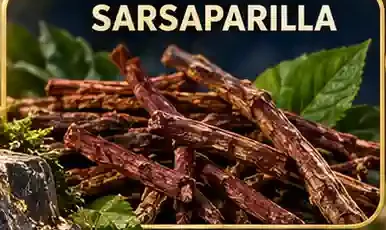
Sarsaparilla
Smilax glabra Roxb. · root, as printed on SodaPeak's labelThe reputation "wild yam" carries in English-language supplement marketing traces to a different species entirely: Dioscorea villosa, native to North America, which became famous in the mid-20th century as a plant source of diosgenin — a steroidal saponin that pharmaceutical chemists once used as a starting material to manufacture progesterone and other steroid hormones in a laboratory. That industrial chemistry fact is where the folk idea that "wild yam contains natural hormones" comes from. The body cannot perform that same laboratory conversion — human physiology doesn't have the enzymatic pathway a chemical plant does — which is exactly the question the actual human trials below set out to test directly, rather than assume.
Trial one: a topical cream, and a null result
The most directly relevant controlled trial on wild yam is a 2001 double-blind, placebo-controlled, crossover study published in Climacteric, the journal of the International Menopause Society.1 Researchers at Melbourne's Baker Medical Research Institute gave 23 healthy menopausal women a topical cream containing Dioscorea villosa extract — the North American species — for three months, alternating with a matching placebo cream, and measured blood and saliva hormone levels alongside symptom diaries.
The result, in the authors' own words: after three months of treatment, "there were no changes in weight, systolic or diastolic blood pressure, or levels of total serum cholesterol, triglyceride, HDL cholesterol, FSH, glucose, estradiol, or serum or salivary progesterone." Symptom scores showed no statistical difference between the active cream and the placebo. The paper's conclusion is direct: topical wild yam extract "appears to have little effect on menopausal symptoms," and the study specifically set out to test — and did not confirm — the claim that wild yam creams influence the body's own steroid hormone levels.
Trials two and three: a different species, oral, twelve months
Two later trials, both from a research group in Taiwan and both published in peer-reviewed journals, tested a different species — Dioscorea alata, Taiwanese yam — given orally rather than as a topical cream, in postmenopausal women, over twelve months.2,3
The first, a two-center, randomized, double-blind, placebo-controlled trial in 50 menopausal women given 12 mg of Dioscorea alata extract twice daily, found a statistically significant reduction in the Greene Climacteric Scale (a standard menopause-symptom questionnaire) after twelve months — most notably for "feeling tense or nervous," insomnia, excitability, and musculoskeletal pain, along with what the paper describes as "positive effects on blood hormone profiles."2 A companion study from the same trial cohort, published in Nutrients, looked specifically at antioxidant activity and lipid profiles and found a more mixed picture: reduced leukocyte counts and improved a marker of oxidative stress (malondialdehyde) at six months, but "did not present positive effects on lipid profiles" after twelve months of low-dose Dioscorea alata use.3
What a menopause-medicine review says about wild yam
A 2014 minireview in Maturitas, surveying herbal treatments for menopause beyond isoflavones and black cohosh, includes wild yam (Dioscorea villosa) in a short list of botanicals with some animal and human evidence for bone and cancer protection — while explicitly cautioning that "further evidence is required."4 That's a fair one-line summary of where the wild yam literature actually sits: promising enough to keep studying, not settled enough to treat as established.
The species-and-population gap, stated plainly
Put the three human studies side by side and a pattern is hard to miss:
| Study | Species tested | Form | Who was studied |
|---|---|---|---|
| Komesaroff et al., 2001 | Dioscorea villosa | Topical cream | Menopausal women (n=23) |
| Hsu et al., 2011 | Dioscorea alata | Oral, 24 mg/day | Menopausal women (n=50) |
| Hsu et al., 2017 | Dioscorea alata | Oral, 24 mg/day | Postmenopausal women (n=50) |
| SodaPeak's label | Dioscorea opposita | Undisclosed share of a root-powder capsule blend | Not studied |
Every controlled human trial that actually exists on a Dioscorea species tested women going through or past menopause, for menopausal symptoms and related hormone markers — never men, never muscle, never strength or stamina. Two of the three trials used a different species than the one printed on SodaPeak's label. None used root powder in an undisclosed-dose proprietary blend. None of that makes wild yam a bad ingredient to include in a formula. It does mean that citing "wild yam" as generically research-backed, without naming which species, which form, and which population was studied, overstates what these three papers actually show.
Sarsaparilla: what the label says
SodaPeak's label is specific here too: Smilax glabra Roxb., root. Sarsaparilla is a common name applied loosely across the genus Smilax — a large group of woody, climbing vines found in tropical and subtropical regions worldwide. Historically, sarsaparilla root (usually from Central American Smilax species) was a 19th-century patent-medicine staple, marketed for everything from "blood purifying" to syphilis treatment, none of which reflected any real evidence even at the time. Separately, and with no real connection to health claims, sarsaparilla-flavored soft drinks and root beer took their flavor from a related but distinct set of plants and botanicals — a culinary footnote, not a clinical one.
The one modern review that names this exact species
The most directly relevant modern research uses the label's own species name: Smilax glabra, known in Chinese medicine as Tufuling. A 2026 systematic review and network pharmacology study in Frontiers in Endocrinology evaluated 56 randomized controlled trials, totaling 4,605 participants, of Tufuling-containing traditional Chinese medicine formulae used for gout.5 The meta-analysis found that these formulae — nearly always combined with other Chinese herbs or with conventional Western gout medication, not used alone — were associated with reductions in pain scores, serum uric acid, C-reactive protein, and inflammation markers compared with Western medicine alone, alongside a lower reported rate of gastrointestinal side effects. The review's own caveats are worth repeating: "the certainty of evidence ranges from low to moderate," adverse-event reporting was incomplete, and the authors call for "further rigorous RCTs" before drawing firm conclusions.
Two things stand out for anyone reading this ingredient on a men's muscle-support label. First: the evidence base for Smilax glabra specifically is about gout and inflammation — uric acid, joint pain, C-reactive protein — not about testosterone, muscle, or stamina. Second: essentially every trial used Tufuling as one part of a multi-herb formula or alongside pharmaceutical treatment, not as a single-ingredient dose comparable to whatever undisclosed share sarsaparilla makes up of SodaPeak's 1,200 mg blend.
A related species, reviewed more broadly
A separate, broader 2024 review in the Journal of Ethnopharmacology covers a different but related species, Smilax china (known as Baqia), cataloguing 134 identified chemical constituents and a wide range of studied biological activities — anti-inflammatory, antioxidant, anti-diabetic, and others — drawn largely from in-vitro and animal work.6 The review's own conclusion is measured: pharmacological studies "have demonstrated some of the traditional uses" of the plant, "while other traditional uses still need to be confirmed by research." Smilax china is not the species SodaPeak's label names, but as a close genus relative its research gives a useful sense of where the wider Smilax literature currently sits — broad phytochemical cataloguing, partial confirmation of some traditional uses, and no research connecting any Smilax species to testosterone or muscle in men.
Same genus, different questions
The honest pattern across both ingredients in this post is the same one: real plants, real research programs, real peer-reviewed trials — asking different questions than the ones a men's "Test Boost" blend implies. Wild yam's best human evidence concerns menopausal symptom relief in women, using species and doses that don't match this label. Sarsaparilla's best modern evidence concerns gout and inflammation, using the label's own species but always as part of a multi-herb formula, not a standalone dose. Neither ingredient has a plain-language federal consumer summary the way an ingredient like saw palmetto does through NCCIH's herb index — which isn't itself a finding of harm or benefit, just an accurate description of how little consolidated public guidance exists for either plant.
Reading "root" ingredients on a proprietary-blend label
Both ingredients in this post share a labeling feature that's easy to miss: they're printed as a genus-and-species name plus a plant part — Dioscorea opposita, root; Smilax glabra Roxb., root — which is more botanical precision than many supplement labels bother with. That precision is genuinely useful, because it's what makes it possible to go find the actual research and check whether it matches. It's also where the trail runs out: SodaPeak's Supplement Facts panel gives no individual milligram figure for either ingredient, no extraction ratio, and no indication of whether the "root" is used as a raw powder, a standardized extract, or something in between. Every human trial cited in this article used a standardized, measured extract — 12 mg twice daily for Dioscorea alata, a defined dose of Tufuling-containing formulae for Smilax glabra. Comparing an undisclosed share of a root-powder capsule blend against those measured doses isn't something the available information allows.
None of that means either root is poorly sourced or mislabeled — the species and plant-part precision on this panel is, if anything, better documentation than a lot of the category provides. It means the responsible reading of "wild yam" or "sarsaparilla" on an ingredient list is narrower than the plain ingredient name suggests: a real plant, with some real research, most of it conducted on a different species, a different dose, and a different population than a men's capsule blend implies.
Bottom line
Wild yam and sarsaparilla are two of the more overlooked names on SodaPeak's ingredient list, and unlike some of the other six, both have genuine controlled human trials behind them. Read those trials for what they actually tested, though, and the picture that emerges is narrower and more specific than the ingredient names alone suggest: different Dioscorea and Smilax species than the ones this label prints, oral and topical doses that were measured and published, and study populations — menopausal women, gout patients — that have nothing to do with the muscle and stamina claims printed on SodaPeak's front label. That's not an argument against either ingredient. It's an argument for reading past the name on a proprietary blend to the species, the dose, and the population an actual study covered.
References
- Komesaroff PA, Black CV, Cable V, Sudhir K. Effects of wild yam extract on menopausal symptoms, lipids and sex hormones in healthy menopausal women. Climacteric. 2001;4(2):144-150. PMID: 11428178.
- Hsu CC, Kuo HC, Chang SY, Wu TC, Huang KE. The assessment of efficacy of Diascorea alata for menopausal symptom treatment in Taiwanese women. Climacteric. 2011;14(1):132-139. PMID: 20653397.
- Hsu CC, Kuo HC, Huang KE. The Effects of Phytosterols Extracted from Diascorea alata on the Antioxidant Activity, Plasma Lipids, and Hematological Profiles in Taiwanese Menopausal Women. Nutrients. 2017;9(12):1320. PMID: 29206136.
- Depypere HT, Comhaire FH. Herbal preparations for the menopause: beyond isoflavones and black cohosh. Maturitas. 2014;77(2):191-194. PMID: 24314619.
- Liu Q, Li X, Lin Y, Tang X, Fan G, Sun L. Multidimensional therapeutic advantages of Smilax glabra (Tufuling)-containing formulae in gout: an integrated Systematic Review and network pharmacology-based prediction. Front Endocrinol (Lausanne). 2026;17:1863098. PMID: 42460320.
- Wang M, Bai QX, Zheng XX, et al. Smilax china L.: A review of its botany, ethnopharmacology, phytochemistry, pharmacological activities, actual and potential applications. J Ethnopharmacol. 2024;318(Pt B):116992. PMID: 37541403.